Category: Jobseekers, General
How Long Should a Graduate Resume Actually Be? We Answer Your Top Questions
Published by Amelia Harper | 5 August 2026
One page or two pages? It sounds like a simple decision, but resume length is one of the most common concerns graduates face when applying for their first professional role in Australia.
As a recent graduate, you may have a degree, casual work experience, internships, projects and useful skills. The challenge is deciding what deserves space and what should be removed. A resume that is too short may leave out valuable evidence, while one that is too long can hide your strongest qualifications.
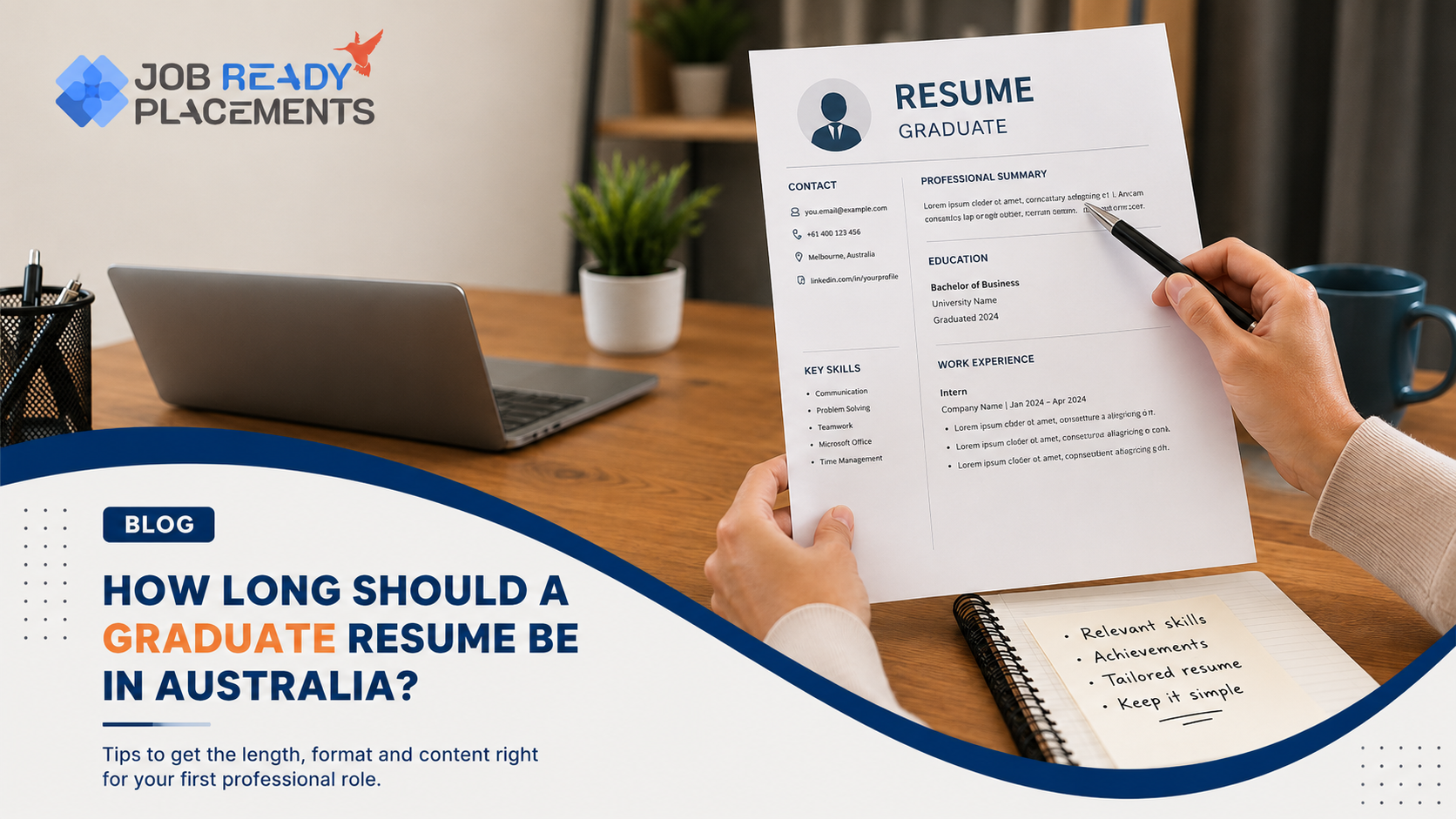
For most graduates, a resume should be between one and two pages. A one-page resume can work when you have limited experience, while a two-page resume is suitable when you have relevant internships, placements, projects, employment or certifications to explain. The goal is not to make your resume as short as possible. The goal is to present your strongest information clearly and give the employer a convincing reason to interview you.
1. Is a One-Page Resume Enough for a Graduate?
A one-page resume can be enough when you are at the beginning of your career and have limited professional experience. It may suit graduates whose background mainly includes a qualification, one casual job, a university project and a focused list of skills.
The main advantage is focus. You include only the details most relevant to the role.
A one-page resume may work when you only need to include:
- Your qualification
- One or two casual or part-time jobs
- One internship or placement
- A small number of university projects
- A focused skills section
- Relevant licences or certifications
However, one page should not become a strict rule. If fitting everything requires tiny text, narrow margins or removing useful projects, the document has become too compressed. A clear two-page resume is better than a crowded one-page document that is difficult to read.
2. When Is a Two-Page Resume Better?
A two-page resume is suitable when the second page contains information that genuinely strengthens your application. Relevant experience does not only come from full-time employment. Internships, placements, projects, casual jobs, volunteering and student leadership can all show that you are ready for the workplace.
Consider using two pages when you have:
- Multiple internships or industry placements
- Relevant casual, part-time or volunteer experience
- Major university or capstone projects
- Professional certifications
- Leadership experience
- Awards, scholarships or portfolio work
Different fields may require different details. A technology graduate may need room for technical projects, while an engineering graduate may need to explain placements and a capstone project.
The second page should add evidence, not filler. Repeating similar responsibilities, adding a long hobbies section or describing unrelated jobs in excessive detail will not make you appear more experienced.
3. What Should Appear on the First Page?
The first page should contain the information most likely to influence the employer’s initial decision. Your strongest qualifications and most relevant experience should appear early.
Start with your full name, mobile number, professional email address and location. Your suburb or city and state are normally enough. You can also add a professional LinkedIn profile, portfolio or GitHub link when relevant.
After your contact details, include a short professional summary. Avoid generic statements such as “hardworking graduate seeking a challenging opportunity.” Instead, identify your qualification, relevant experience and strongest skills.
For example:
“Recent Bachelor of Commerce graduate with internship experience in financial reporting, customer service and data analysis. Confident using Microsoft Excel, with strong communication and problem-solving skills.”
Your education should usually appear near the top. Include your degree, institution, major and completion date. You may also mention an award or capstone project when it directly supports the position.
The rest of the first page should begin presenting your most relevant experience. This could be an internship, placement, casual job or university project. Lead with the experience that most closely matches the employer’s requirements.
4. How Much Work Experience Should You Include?
Your employment section can include internships, placements, casual jobs, part-time work and relevant volunteering. The role does not need to be identical to your target profession to be useful.
A job in retail, hospitality or customer service may demonstrate:
- Communication and teamwork
- Reliability and punctuality
- Problem-solving
- Time management
- Ability to work under pressure
- Customer-service skills
Avoid listing only basic duties. Focus on how you contributed, what skills you used and what outcomes you achieved.
Instead of writing:
“Responsible for helping customers and using the register.”
Write:
“Assisted customers in a fast-paced retail environment, processed transactions accurately and worked with team members to resolve service enquiries.”
This gives the employer clearer evidence of communication, accuracy and teamwork. Older or unrelated jobs can still be included, but they usually need less detail.
5. Should University Projects Be Included?
University projects can be some of the strongest evidence on a graduate resume, especially when you do not yet have extensive paid experience.
A relevant project can demonstrate research, problem-solving, teamwork and technical ability. For each important project, explain:
- What the project aimed to achieve
- What your individual responsibility was
- Which tools or methods you used
- What result was produced
Instead of writing:
“Completed a group digital marketing project.”
Write:
“Developed a digital marketing strategy for a local business as part of a four-person team, using audience research and social media analytics to improve customer engagement.”
You do not need to include every assignment completed during your degree. Choose the projects that most closely match the role and add a portfolio or GitHub link where appropriate.
6. What Should You Remove if the Resume Is Too Long?
A resume becomes too long when it contains information that does not help the employer assess your suitability. The first solution should be editing the content, not reducing the font size.
Remove or reduce:
- Outdated school achievements
- Unrelated or expired certifications
- Repetitive job descriptions
- Generic career objectives
- Long hobbies sections
- Full residential addresses
- Unnecessary personal information
- “References available upon request”
Older casual jobs can often be shortened to one or two strong points. Avoid repeating the same communication and teamwork claims under every role. Use each experience to demonstrate a different strength.
Every line should answer one question: does this make me a stronger candidate for this job? If the answer is no, remove it or reduce the space it receives.
7. Does Formatting Affect Resume Length?
Formatting has a major effect on how professional and readable your resume appears. A one-page resume can still feel too long when it contains dense paragraphs, tiny text and inconsistent spacing. A clean two-page document can be much easier to review.
Use clear headings, a professional font, concise bullet points, consistent dates and appropriate spacing. White space helps employers find information quickly and prevents the document from looking crowded.
Avoid complicated templates, excessive graphics and decorative elements. Important information should not be hidden inside images, unusual text boxes or complex layouts.
Do not force everything onto one page by reducing the font until the document becomes difficult to read. Formatting should improve clarity rather than manipulate the page count.
8. Does Resume Length Change Between Industries?
The one-to-two-page guideline works for most graduate applications, but the information you prioritise will depend on your industry.
Technology graduates may need space for projects and GitHub links, while engineering graduates may highlight placements and software knowledge. Creative graduates can use a portfolio to show detailed work. Healthcare and education graduates may need to include placements, registrations and practical training.
Academic and research applications are different because a longer curriculum vitae may be expected. Always follow the employer’s instructions when a specific page limit or document format is provided.
9. What Is the Biggest Mistake Graduates Make?
The biggest mistake is focusing on page count instead of the quality and relevance of the information.
Some graduates remove strong projects and internships because they believe every entry-level resume must fit onto one page. Others stretch limited information across two pages by adding generic skills, long personal statements and unrelated activities. Neither approach improves the application.
Before submitting your resume, check that:
- Your strongest information appears near the beginning
- The content is tailored to the advertised role
- Experience points describe contributions, not only duties
- Relevant projects and placements are included
- Repetitive information has been removed
- Formatting is clean and easy to scan
- Contact details and spelling are correct
The Final Answer
For most graduates in Australia, a resume should be one to two pages long. Use one page when your relevant information fits comfortably and clearly. Use two pages when you have internships, placements, projects, certifications, casual employment or leadership experience that deserves additional explanation.
Do not remove valuable evidence simply to meet an unofficial one-page rule. At the same time, do not add filler to make the resume appear more substantial.
The strongest graduate resume is not necessarily the shortest or the longest. It is the resume that presents your qualifications, skills and achievements clearly and gives the employer a convincing reason to invite you to an interview.
Sources and References
1. Workforce Australia – Write a Resume
https://www.workforceaustralia.gov.au/individuals/coaching/job-applications/resumes
Official Australian guidance on resume length, structure, relevant skills and tailoring applications to each job.
2. UNSW – Career Advice for University Students
https://www.unsw.edu.au/study/your-future/career-advice-for-uni-students
Explains that two pages is a common resume length in Australia and discusses how students can present transferable experience.
3. University of Sydney – How to Write a Resume
https://www.sydney.edu.au/careers/students/applying-for-jobs/how-to-write-a-resume.html
Provides guidance on structuring work experience, highlighting achievements and presenting information in reverse chronological order.
4. University of Queensland – Tips for Writing Your First Resume
https://study.uq.edu.au/stories/tips-writing-your-first-resume
Offers practical advice on one-to-two-page resumes, relevant experience, formatting and tailoring content to the role.
5. University of Technology Sydney – Resume Checklist
https://www.uts.edu.au/globalassets/sites/default/files/ssu-cs-resume-checklist.pdf
Includes a student resume checklist covering page length, headings, bullet points, dates, formatting and readability.
6. Deakin University – DeakinTALENT Resume Guide
https://www.deakin.edu.au/__data/assets/pdf_file/0010/2686249/DeakinTALENT-Resume-Guidev4.pdf
Provides graduate-focused guidance on resume content, presentation, tailoring and keeping the document concise.
#GraduateResume #ResumeTips #AustralianJobs #JobReady #CareerAdvice #GraduateCareers #JobSearchTips #EntryLevelJobs #ResumeWriting #AustralianGraduates #CareerDevelopment #ResumeHelp #GraduateJobs #EmployabilitySkills #JobApplicationTips #CareerSuccess
Read More Articles: From Resume to Interview: Essential Tips to Get Hired Faster